It’s compulsory for all pupils aged 3-18 in Scotland. It has been for hundreds of years. Yet no one knows what it is! Welcome to What is RME!
I am currently undertaking a research project into ‘What is RME?’ – this is a study into what happens in RME lessons in Scotland. It is clear from my initial research, that no-one really knows. The guidance on what should be happening e.g. The Curriculum for Excellence, although allows for autonomy and professional judgement, also can be argued to be vague and therefore this leads to plethora different interpretations of what should be happening in RME and what does good RME look like. These misconceptions can ultimately lead to RME’s marginalization. (Schreiner, 2020)
What is the problem with RME?
There have been countless studies into what is Religious Education. Different curricula across the world have different ideas about RE. Some want students to learn about religion, some want them to learn from religion. How can pupils learn from religion, when they barely get the space and time to learn about it. (Conroy et al, 2011)
RME in Scotland is a compulsory subject from 3 -18 years old, however it is extremely rare that schools are providing high quality RME up until pupils are 18. In fact it is becoming more and more rare for pupils to access Core RME beyond S2 in Secondary School. And then we have the debate of is certificated RMPS the same as RME? Which is something that through my research I hope to look into further.
The Principles and Practices Document outlines the ambitious vision for RME that it should
Learning through religious and moral education enables children and young people to:
https://education.gov.scot/media/nfhlnnm1/rme-pp.pdf
- recognise religion as an important expression of human experience
- learn about and from the beliefs, values, practices and traditions of Christianity and the world
religions selected for study, other traditions, and viewpoints independent of religious belief- explore and develop knowledge and understanding of religions, recognising the place of Christianity in the Scottish context
- investigate and understand the responses which religious and non-religious views can offer to questions about the nature and meaning of life
- recognise and understand religious diversity and the importance of religion in society
- develop respect for others and an understanding of beliefs and practices which are different from their own
- explore and establish values such as wisdom, justice, compassion and integrity and engage in the development of and reflection upon their own moral values
- develop their beliefs, attitudes, values and practices through reflection, discovery and critical evaluation
- develop the skills of reflection, discernment, critical thinking and deciding how to act when making moral decisions
- make a positive difference to the world by putting their beliefs and values into action
- establish a firm foundation for lifelong learning, further learning and adult life.
- Religious and moral education is therefore an essential part of every child or young person’s educationalexperience.
Put Simply, we are looking for RME teachers to get a room full of infants, children or teenagers to learn about religion, the basic knowledge and understand how religions work. In addition to this, they need to understand the nuance of religious diversity in society. After we have done that, we can then teach pupils how to develop respect for others and learn from the religious ideas. In amongst all of this we are then looking to establish quite massive values of wisdom, justice, compassion and integrity. We will then, reflect upon our beliefs, views and actions. All the while, we also have to work out how we are going to make a positive difference in the world and encourage pupils to continue this learning beyond the classroom.
An Hour a Week to Change the World
All of these are absolutely vital in society, some would argue in 2025 that the understanding of and developing respect for others is as crucial now as ever. But, please bear in mind that if we are lucky this is for about an hour a week for 38 lessons a year. Core lessons also tend to be the first ones hit when it comes to planning an assembly timetable, “it’s just a core period”. “I’ll take you out of Core RME to finish that piece of work”, “When’s your core time to arrange that appointment?” or “to minimise disruption we’ve tried to use pupils core period”.
Other issues that we haven’t even touched upon yet are school wide issues such as phones, behaviour issues, differentiating to the needs of the learners, planning engaging lessons that meet the schools learning and teaching policy, allowing coverage of breadth and depth and giving meaningful feedback. We are asking pupils to have quite big conversations, before we do that we need to build trust and rapport with them. That takes time which many schools are just unwilling to provide on the overloaded curriculum. This can therefore lead to teachers sticking to ‘safe’ knowledge based lessons, with simple measures of assessment that pupils can engage with and don’t take a month to get the same level of depth a colleague that has more space on the timetable can cover in a week. The limited time and space in the curriculum definitely does a disservice to the amazing subject that RME is and can be.
Interpreting the Curriculum
Even with the principles and practices document, the experiences and outcomes and benchmarks it could be argued that the curriculum is still very vague. This was the premise of CfE, teachers should be allowed to develop a curriculum to suit their context. However, this is also the issue with CfE, it leads to some interesting interpretations of what should be taught.
I just want to show a little comparison here to show the work that might need to go into achieving a benchmark in RME.
RME – Investigates, describes, explains and expresses an opinion on at least one belief from Christianity, at least one World Religion, and at least one belief
group independent of religion.Social Studies – Identifies at least three features of Scotland’s
landscape and can provide a basic explanation of how these are formed.Mathematics – Calculates simple fractions of a quantity and uses this knowledge to solve problems, for example, find 3/5 of 60.
These are 3 examples of benchmarks from level 2. The examples from Social Subjects are quite clear in what they require of the learner. I am a qualified history teacher, but even regardless. I think I could plan and assess pupils quite easily on that benchmark. I could even give the Maths one a good attempt, or at least I know what the assessment would look like.
The RME one is based on a belief but lists four skills and three viewpoints. That’s 12 things we are assessing here. In limited time, in limited capacities. But also they only need to look at one belief. Should we not be pushing learners to look at a range of beliefs. Do we have specific beliefs to look at? A pupil could go through all their schooling only ever studying one belief.
Furthermore, what level of depth are we looking at here when we are asking pupils to investigate? How much description and explanation are we needing? Is calling a group of people a bunch of idiots enough of an opinion expressed? This is the issue with this benchmark – each school can interpret that very differently and when other pressures are upon us teachers have a tendency to play it ‘safe’ and approach using a quantitative tool that maybe doesn’t quite fit the true meaning of the benchmark. (Grant and Matemba, 2013)
Rebranding of RME
There are so many calls to rebrand RME to RMPS, or even something completely different. There does need to be a rebrand of the subject but we need more than just a fresh coat of paint. We need the substance behind it. We need a radical change which I hope will come with the new curriculum.
Assessment in RME
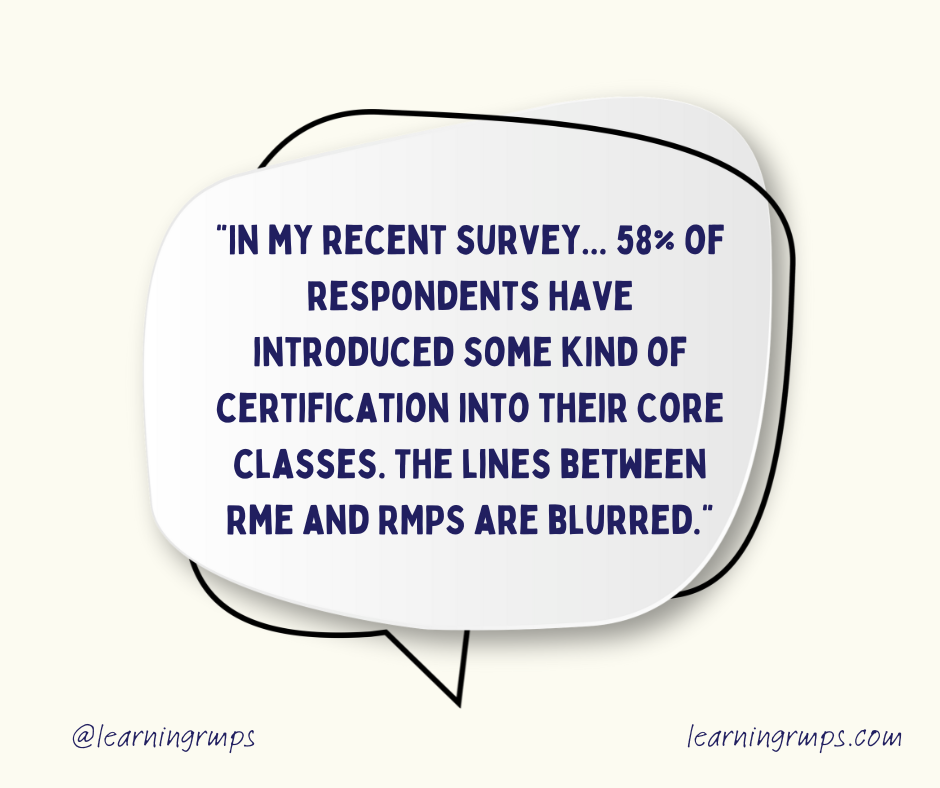
Linking into this argument of rebranding is do we need to be clearer what the difference is between RME and RMPS? RMPS is the certificated, SQA qualification. RME is the Core subject that all pupils are entitled to. But, the lines are blurred. With many schools certificating their core classes. In fact, in my recent survey where I asked what happens in RME classrooms, 58% of respondents have introduced some kind of certification into their Core classes. This is something, I would like to pick up further – what should Core RME be? Is it just another opportunity for another Qualification? Should there be an SQA accreditation of RME as opposed to RMPS? This is something Scholes discusses in his paper, The Marginalization of Religious Education: Solutions for a Shared Challenge from Scotland
As part of my initial research and survey results, there are so many strands of research that I want to pick up upon. In fact this is probably a lifetime of work. Many of the strands, I haven’t even touched upon here. We are at a crucial time in Scottish Education. The world has changed so drastically since the last curriculum was written. It is no longer fit for purpose but I think we need to be clearer on what the purpose should be. And how to ensure that it is achievable and accessible for all.
If you would like to learn more about the podcast you can find it here.