I tried something different last year with teaching world religion, and it felt like it worked better. Obviously, I won’t know for sure until the exam results come out, but initial pupil feedback has been incredibly positive. In fact, an unexpected question came up in the exam, but it didn’t throw them at all. The pupils actually described it as a “dream of a question,” so I thought I would share my approach to see if it works for others.
This year, I changed to teaching Sikhism. We previously taught Islam, but we moved that down to National 5. Before that, we taught Buddhism, but we felt it was a bit too abstract and didn’t quite fit our local community – especially since we have a Sikh community within our school.
Admittedly, I didn’t know an awful lot about Sikhism initially, so I had to teach myself a lot of the content. I used the book Understanding Sikhism by James Holt to help with this. James has written a whole host of teacher guides to religions including Judaism, Hinduism and Buddhism. However, when it came to the classroom, I structured the lessons slightly differently.
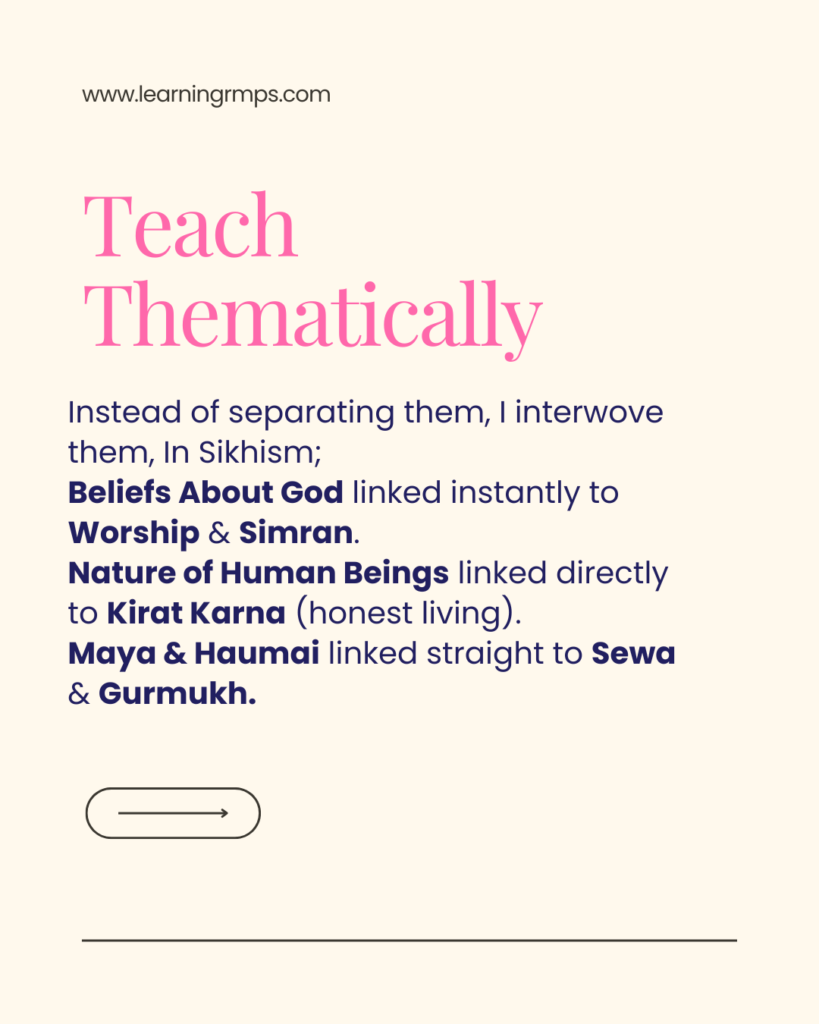
Rather than strictly following the Course Assessment Specification (CAS) order of teaching all the beliefs and then all the practices, it made more sense for me to teach thematically. I started with fundamental beliefs and built upon them through central themes. This allowed me to show the links between beliefs and practices much more easily, making the analysis far more straightforward for the pupils. When it came to writing essays, they could naturally build connections between beliefs and practices, reinforcing and layering their foundational knowledge each time.
So, how did I do this?
Before the summer holidays, I spent time ensuring my class was well-cemented in basic Sikh knowledge. To give them a whistle-stop tour, I asked them to create a cheat sheet of key Sikh terms and practices using non-fiction children’s books. I set a quiz that required them to use these books for answers, ensuring they wouldn’t be overwhelmed by the vast amount of information on the internet (it also got them used to using a physical book as a source!). We also watched videos, such as My Life, My Religion: Sikhism, to help them visualise what the faith looks like in practice.
After the holidays, we began building our foundational knowledge. I taught ‘Beliefs About God‘ and immediately linked this to ‘Worship and Simran‘, as well as introducing the Khalsa and the Gurdwara. At this stage, we also discussed the Gurus, focusing specifically on the lives of Guru Nanak and Guru Gobind Singh, alongside the teachings of the Guru Granth Sahib. This provided a substantial and manageable foundation for the pupils.
Next, we moved on to the ‘Nature of Human Beings‘. We explored the key ideas within this topic and linked them directly to Kirt Karna (honest living)—connecting the Nature of Human Beings, Atma, Free Will, Karma, and Equality to how Sikhs are encouraged to act.
After that, we covered Maya and Haumai, linking these concepts to Sewa and becoming Gurmukh. We looked at what the ultimate goal is, how to get there, and The five evils that stand in the way. I asked the pupils to learn about three of the five evils in detail. This naturally built upon their prior knowledge of beliefs about God and human nature.
Finally, we focused on ‘Community’ and Khalsa. We looked back at the Gurdwara and the lived experience of Sikhs, connecting this to the beliefs and practices we had learned throughout the course. We discussed how the Khalsa influences Sikhs today and how they live according to the Gurus’ teachings, which included looking at Jivan Mukti and Vand Chakkana.
By interweaving practices, building on knowledge, and explicitly drawing connections, revision became much less daunting for the pupils. It also meant I could set prelim questions on almost any topic rather than being limited in my choices. As I mentioned, when the exam threw up an unexpected question, the pupils weren’t fazed because they could bring in learning from across the entire unit.
Because this was a whistle-stop tour, I prepared blank knowledge organisers for them. For each heading in the CAS, they needed to provide up to 10 pieces of knowledge, alongside a brief comment on how that heading linked to the others. We did this throughout the course, building on knowledge but showing how it linked to each question that could be brought up in the exam. I also had a list of every different possibility of question that could be brought up in the exam and the years that question was asked so pupils knew what hadn’t come up yet and look back at marking schemes.
If I were to offer any advice to those who have been teaching Higher for a while, it would be to reflect critically on your course content. Take out anything you can. Yes, it might be interesting, and yes, it is part of the religion, but is it strictly necessary for the exam? At the end of the day, 10 key points for each heading is not a lot.
If we look at the ‘Nature of Human Beings’, for example, there are four sub-headings: Atma, Equality, Karma, and Free Will. If pupils know 6 Knowledge and Understanding (KU) points for each of these, that equates to 24 KU marks for a ‘Nature of Human Beings’ essay. A helpful way to streamline your teaching is to write a model answer for a 20-mark question on just one of the bullet points. Ultimately, that is all you need to teach them. If they can write a 20-mark answer, they can easily handle a 10-mark question on that topic.
Secondly, if you really want to refresh your curriculum, try teaching a world religion you currently know very little about. It stops you from overfilling the curriculum with excess information, and as your own confidence grows, you can gradually layer in small anecdotes or stories.
I hope this provides some food for thought for anyone about to restart their Higher teaching blocks this year. I’d love to hear if this approach works for you!